Bite-Sized SEO for a Limited Budget

Since Search Engine Optimization (SEO) isn’t a one-and-done process, it can easily overwhelm an organization’s resources. SEO is so much more than keyword research and content generation, and there are bite-sized efforts anyone can take to enhance their organic search results. Here is what the experts on our team recommend:

1. Focus on Local SEO

Local SEO is one of the higher-impact, lower-cost items. If you have a brick-and-mortar location and set business hours, this is a must. At its most basic, this step involves reviewing Google’s guidelines for local SEO and making sure your Google Business Profile, as well as Meta, Bing, and other platforms where your listing appears, are accurate, complete, and kept up to date. Consistency is important, so this is a place where you might consider paying the small monthly fee for a service that monitors and manages your listings to ensure your company information matches across all directories. Read one of our previous blogs in this SEO series to learn more about putting your business on the map with Google Business Profile and other tips on implementing a local SEO strategy.

2. Reframe Your Approach to Content

Quality content is important for SEO rankings and creating an engaged user experience. Focus on leveraging your team for ideas. Encourage them to track questions that clients and customers ask, as those can become topics for future content pieces. For those with the resources to generate relevant content themselves, 5 Horizons offers site reviews, competitor gap analysis, keyword research, and creative brief development to inform your content creation. Tip: If you don’t have the resources to write new content yourself or hire somebody to do it, try featuring your social feed on your website. This may require some up-front development work, but as long as your social channels are updated frequently, this can provide fresh content to encourage audience engagement.

3. Monitor Technical SEO and Website Performance

It’s vital for you to continuously look at and promptly adjust your website’s technical performance. Technical SEO can be monitored in Google Search Console, which will give you insights into major technical issues, such as broken links (404 pages). Page Speed Insights is a great resource that looks at Core Web Vitals, which are important web page performance metrics that can help you identify problems such as slow loading speeds and poor mobile performance. These services don’t cost anything and can help you significantly optimize your website.


Even when resources are limited, SEO is an important part of your web presence. Applying even a few additional steps to your existing SEO efforts could increase your search engine rankings and help you connect with your target audience. At 5 Horizons, we work with different SEO budgets and customize our approach for each client. Contact us to discuss how we can help your business grow, and read other blogs in our Demystifying SEO series.


Technology background of the abstract computer motherboard, can be used in the description of technological processes, science, education. Can be used as digital dynamic wallpaper. 3d rendering

Unlocking SEO Potential at MozCon

A Look Back at MozCon 2023 as We Prepare for the 2024 Conference


In August 2023, our technology team attended MozCon 2023 in Seattle and spent two full days learning, talking, and exploring innovative ways to implement Search Engine Optimization (SEO) and all of the facets that surround best SEO practices.

Our team arrived back on the east coast ready to share all of their ideas with the full company and begin implementing everything they learned. After spending some time putting their new education into practice, they have highlighted the greatest takeaways from last year’s conference.

Here are the top three topics that our team highlighted as most important after MozCon 2023:

1. Google is a Digital Ecosystem

Google is only one search engine among many, but it stands out from all the rest because of its broad expanse of offerings. Google is now a social network, a business directory, a place to shop, a place to image search, an aggregator, and a personal assistant––all rolled into one.

Thinking of Google as a digital ecosystem encouraged our team to incorporate all Google had to offer into our strategy and web presence going forward. SEO is equally interconnected and needs to be woven into all layers of content, campaigns, websites, and ads from start to finish. Google is currently the expert on users’ motivations for search and data collection, making Google the key to connecting with targeted audiences.

How our team is using Google differently in 2024:

  • Not thinking of Google solely as a search engine
  • Not getting sucked into the algorithm-thinking SEO practices
  • Using Google’s offerings to find and retain target audiences
  • Exploring content beyond just web pages––especially indexed YouTube video
  • Focusing on identifying local link opportunities in addition to traditional backlinks

2. GA4 Offers Privacy Conscious User Data

Google Analytics 4 (GA4) is a customizable tool our technology team uses to measure traffic and engagement across the websites that we create, optimize, monitor traffic, and study user behavior. In order to address privacy concerns, Google moved away from Universal Analytics (UA) and implemented the GA4 data structure to collect, store, and use data in a way that is compliant with privacy regulations in different countries/states while focusing on events rather than sessions. It uses modeling to estimate conversion data that can’t be observed directly without identifying users. GA4 aims to collect user web and app data  in a privacy conscious manner while preparing for a cookieless browsing future.

How our team is leveraging GA4 in 2024:

  • We are using GA4 to track user behavior and sources of traffic
  • We are using the funnel report builder to analyze flows and track conversions
  • We are customizing our team’s navigation for easy access to useful reports
  • We are building custom audiences and using them for remarketing in Google Ads
  • We are using GA4 to measure the impact of our paid media efforts 
  • We are using GA4 to create custom reports to extract key insights for decision making 

3. AI and the Rise of Large Language Models

Artificial Intelligence (AI) is not new, but universal accessibility to it is. Like many, our team regards AI with equal parts skepticism and curiosity. While at MozCon our team approached new information about AI with an open mind and challenged their own beliefs to embrace experimentation.

ChatGPT is a natural language processing tool developed by OpenAI to generate human-like text based on input. OpenAI trained ChapGPT on a massive amount of text data from the internet, using a machine learning model known as a large language model (LLM). ChapGPT “learns” by identifying patterns in the data and uses them to make predictions.

After Open AI launched ChatGPT, many companies such as Microsoft and Google started to integrate ChatGPT into their search engines or created their own LLMs, such as LaMDA/Bard and Bing Chat.

How our team is leveraging AI in 2024:

  • Increasing efficiency as a digital partner and personal assistant
  • Solving problems and expanding research
  • Learning better skills for prompting AI
  • Integrating ChatGPT functionality into other applications
  • Increasing transparency when using AI and sharing it’s benefits with each other
  • Continuing to explore all that AI has to offer our company workflow

Our technology team was thrilled to learn all they could from MozCon in 2023 and are very excited to gain even more exposure to new technologies at MozCon in 2024.

Education is at the heart of everything we do. If you are looking for a partner who is constantly exploring and learning new technology, we are ready to share our knowledge with you and solve your digital marketing problems. Let’s connect!

Leadership, individuality, difference and standing out from the crowd. Unique thinking and creativity. Do not go with the flow.

Celebrating Our 2023 Wins + Planning for Our 2024 Successes

2023 brought 12 months of growth for our team. We welcomed four new employees and five new clients, putting in hundreds of hours building up our offerings.

As always, education and professional development are at the forefront of our company culture. Our team attended three conferences and exhibited at two, networking with new connections and expanding our skills in design and technology.

2023 was a website heavy year––our team built over 43 websites, spending over 1,000 hours writing, designing, constructing, and testing. We created nearly 500 digital ads and worked on 228 unique projects of varying complexities. Our data and tech team completed three extensive SEO audits and got the ball rolling on six more. We also launched two new Marketing Automation systems in Salesforce’s Marketing Cloud.

As we move into 2024, we are excited for the new opportunities on the horizon––including clients, design techniques, and innovative strategic methods––all delivered with the same quality and care we’ve prioritized for the last 11 years.

Visit our website for fresh ideas and upcoming trends on our Insights page, and take a look behind the curtain under Projects to see how we handled different client challenges. Follow us on social media for day-to-day updates or reach out through our contact form to chat with us directly.

At 5 Horizons we solve problems using creativity, technology, and data to help our partners grow. We look forward to being your partner in 2024.

– Pat Riley & Ben Sandman

Co-Founders, 5 Horizons

Abstract arrow direction. Technology background

Demystifying SEO

A new blog series for understanding the ins and outs of SEO.


Search engine optimization (SEO) is the process and strategy of increasing search result visibility for businesses. With technology changing and evolving every day, SEO strategies are constantly in flux.

In our new series Demystifying SEO, our team is doing a deep dive into the complexities of SEO and how you can begin implementing best practices into your own marketing plan.

The Basics 

In the first section of the series, we’ll cover the basics:

How We Implement SEO

In the second section of the series, we’ll address the challenges surrounding SEO:

Where is SEO Going Next?

And in the third section of the series, we’ll cover where we think SEO is headed next:

Follow our Demystifying SEO series to learn how SEO is more than just content, how it requires a thorough strategy and involves intent-focused keyword research. Or contact us to discuss conducting an SEO audit to help your business thrive.

A/B TEST Laptop on table man work test

What is A/B Testing and How to Use It?

A beginner guide to A/B testing and achieving quick results.

What is A/B testing?

A/B testing, sometimes referred to as “split testing,” is a user experience research method that compares two versions of something to learn which performs better. When it comes to ever-evolving digital advertising, A/B testing is extremely important, as it helps us learn new strategies to improve our campaigns.

Benefits of A/B testing?

A/B testing can help you implement long-term strategies and solutions for your brand or your clients. A/B testing is highly customizable to fit everyone’s individual needs and goals, but here are some common benefits of A/B testing:

  1. Make data-backed decisions

A/B testing takes the guesswork out of your advertising and marketing campaigns, enabling you to make informed choices when it comes to optimizing your content.

  1. Reduce bounce rates

With A/B testing, you can try out different tactics of retaining your leads and audience on your website longer, increasing the likelihood of them interacting with your content.

  1. Quick results

In a fast-paced world of digital marketing, quick and reliable results are crucial for increasing campaign effectiveness. Even a relatively small A/B test can provide significant, actionable results that allow for low-risk modifications and improved campaign performance.

How do you start A/B testing? 

  1. Carve out a portion of the budget to test with (percentage allocation will depend on the overall client budget). The remaining budget should be prioritized for the highest-performing campaign.
  2. The A/B test campaigns should always run at the same time. The only variable that should be different is what’s being tested—everything else, such as flight, budget, and audience should be the same.
  3. The testing period should be set for about 2-3 weeks, no matter which of the two tests (or both) you decide to move forward with.
  4. The key performance indicator (KPI) of A/B testing for lead generation campaigns should be Leads/Cost-Per-Lead (CPL), and the KPI for brand or traffic campaigns should be website traffic or clicks.

Want to learn more about A/B testing for specific social media platforms? Read our blog on the importance of LinkedIn A/B testing or contact us to learn how our team can help your content stand out.

Businessman analyzing company's financial balance sheet working with digital augmented reality graphics. Businessman calculates financial data for long-term investment.

Inside 5 Horizons: A/B Testing on LinkedIn

Danielle Romano, Director of Performance and Analytics, shares her thoughts on the necessity of LinkedIn A/B testing.


A/B testing is an essential experiment for determining which form of content performs better on a platform and drives higher engagement and results. Here is what Danielle’s team has discovered through experimenting with LinkedIn A/B testing.

What can you A/B test on LinkedIn?

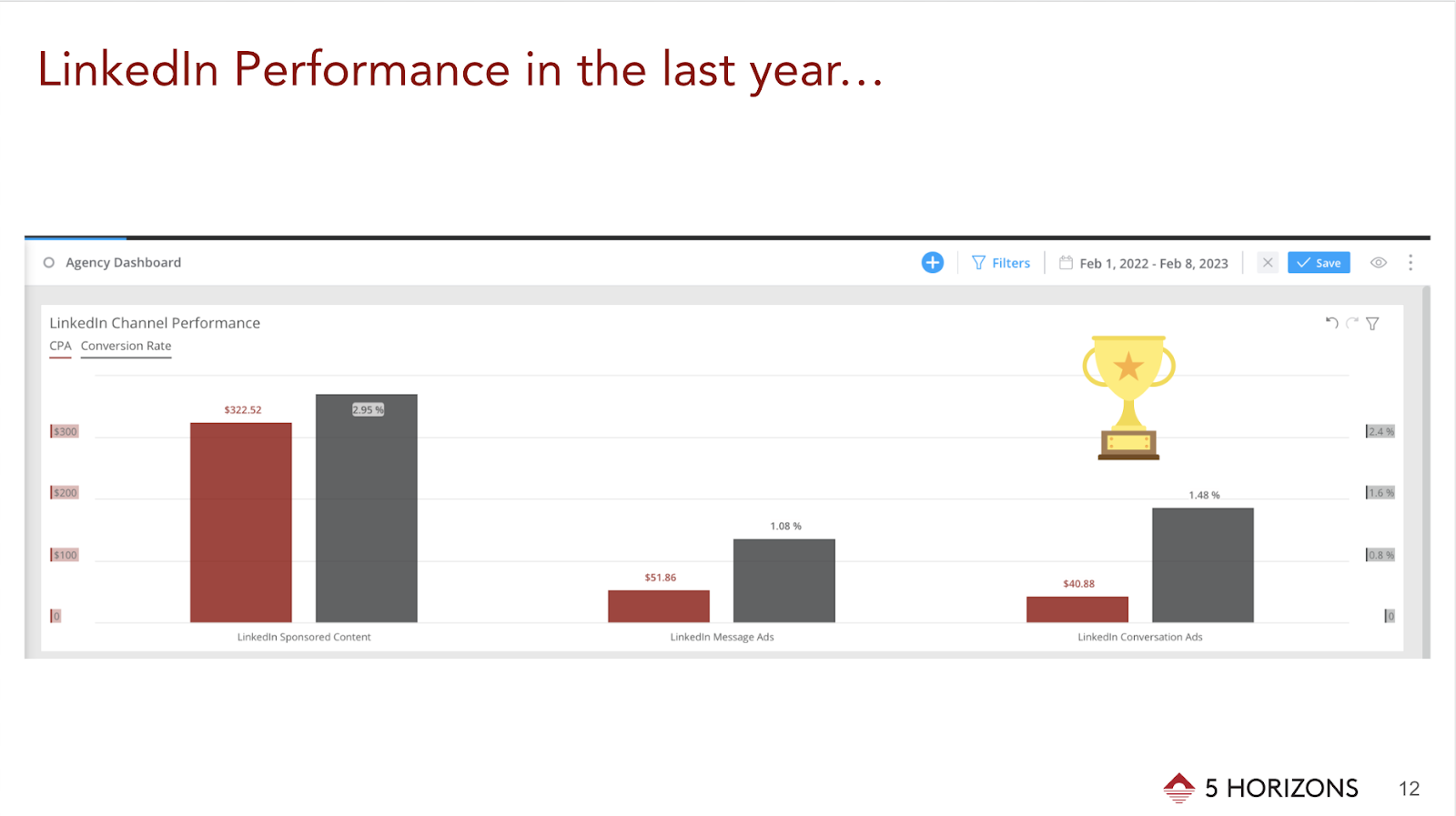
Through A/B testing, we learned that LinkedIn Conversation Ads performed best for our higher education clients and generated the most leads. We hypothesize that we saw such a significant increase in results because the Conversation Ad format provides just the right amount of context for people to act and request more information. 

Things to keep in mind when considering A/B testing for this platform:

Copy Length

Short and long copy speaks to how much information and details someone needs to take action, and experimenting with different text lengths can help establish best practices for the future.

Ad Formats 

LinkedIn offers a variety of ad formats to choose from, all of which can be put to A/B testing to find out which format is the most successful for specific objectives.

Text Ads

Text ads are a great format to use when the message is clear and concise—brand campaigns typically benefit from this LinkedIn ad type. When it comes to our practice, we don’t usually reach for this format because we run program-specific campaigns for our higher education clients. Through A/B testing, we learned that such campaigns perform better when additional copy and visuals are present.

Sponsored Content

This format works well for event ads or advertising programs at a brand level. We typically run in-app lead generation campaigns using this format with a program brochure or a “request more information” call to action as our incentives.

Conversation Ads

Conversation Ads tend to succeed when used for a program that may be unique or requires additional context. This strategy also works well for smaller clients because it goes directly to the users’ inboxes without having to fight for space in the feed.

Document Ads

Document Ads are new to Linkedin, but we anticipate this format to become a new way of advertising program brochures or any relevant learning materials that can be easily formatted as a .pdf file.

Images 

  • Images of people vs. images of objects: Sometimes a photo of a person in business attire works well for a client, other times a textbook with a client logo outperforms elsewhere. 
  • Branded imagery vs. non-branded imagery: Well-known brands typically generate better engagement rates when there is a logo associated with the image, whereas local or smaller brands can blend in with the feed through a more organic image, without any branding. 

These tips and resources can be used to start and better understand the importance of A/B testing for any brand or client. If you’re curious to learn more about LinkedIn, read our 2023 LinkedIn Updates and stay up-to-date on how to use the platform to its fullest potential.

The Inside 5 Horizons series includes stories and perspectives from our amazing team. Get a glimpse into our company culture each month by hearing the unique voices of our copywriters, strategists, project managers, and more.

June 8, 2019 Mountain View / CA / USA - Google office building in the Company's campus in Silicon Valley; The "double o's" of the logo are decorated in rainbow colors in honor of LGBTQ Rights

What Does it Mean to be a Google Premier Partner for 2023?

This St. Patrick’s Day it’s not luck, it’s hard work.


5 Horizons has been named a Google Premier Partner for 2023. Many of our clients come to us for Google Ads assistance. Becoming a Google Premier Partner takes a lot of time and hard work. 


“We’re excited to recognize your company as a 2023 Premier Partner and for being in the top 3% of partners in your country. Achieving Premier Partner status is an accomplishment worth celebrating, and distinguishes your company as a Google Ads expert to clients and the industry.” – Google


As a Google Premier Partner, 5 Horizons has achieved and exceeded all requirements, while demonstrating continuous success with:

  1. Certifications
  2. Ad spend
  3. Performance

Our team is constantly looking to improve our skills with Google Ads and this recognition is proof of it.

How Does That Help Our Clients?

As a Google Premier Partner, we receive a variety of benefits from Google, allowing us to provide additional services for our clients.

Benefits include:

  • Dedicated Account Management
  • Google Partner Search Listing
  • Client Event Support
  • Networking with Other Agencies
  • Executive Business Trainings for Our Employees
  • Dedicated Support Representatives & Teams
  • Annual Partners Summit & Review
  • Google Partners Badge 

Ready to Work With Us?

As Google Premier Partners, we know how to achieve success with Google Ads. Reach out to us today if you’re looking to improve your advertising strategy. 


How to Build a Direct Response Enrollment Marketing Strategy

How to Build a Direct Response Enrollment Marketing Strategy

Presented at the National Council for Marketing & Public Relations (NCMPR) D1 Conference in Fall 2022


In October 2022, our team traveled to New York for the NCMPR D1 Conference and shared our insights on building a direct response enrollment marketing strategy at community colleges.

Direct response marketing has proven to be particularly effective for higher education. We compiled our top tips on how you can enhance your strategy, increase lead generation, and optimize lead progression.

1. Know Your Data

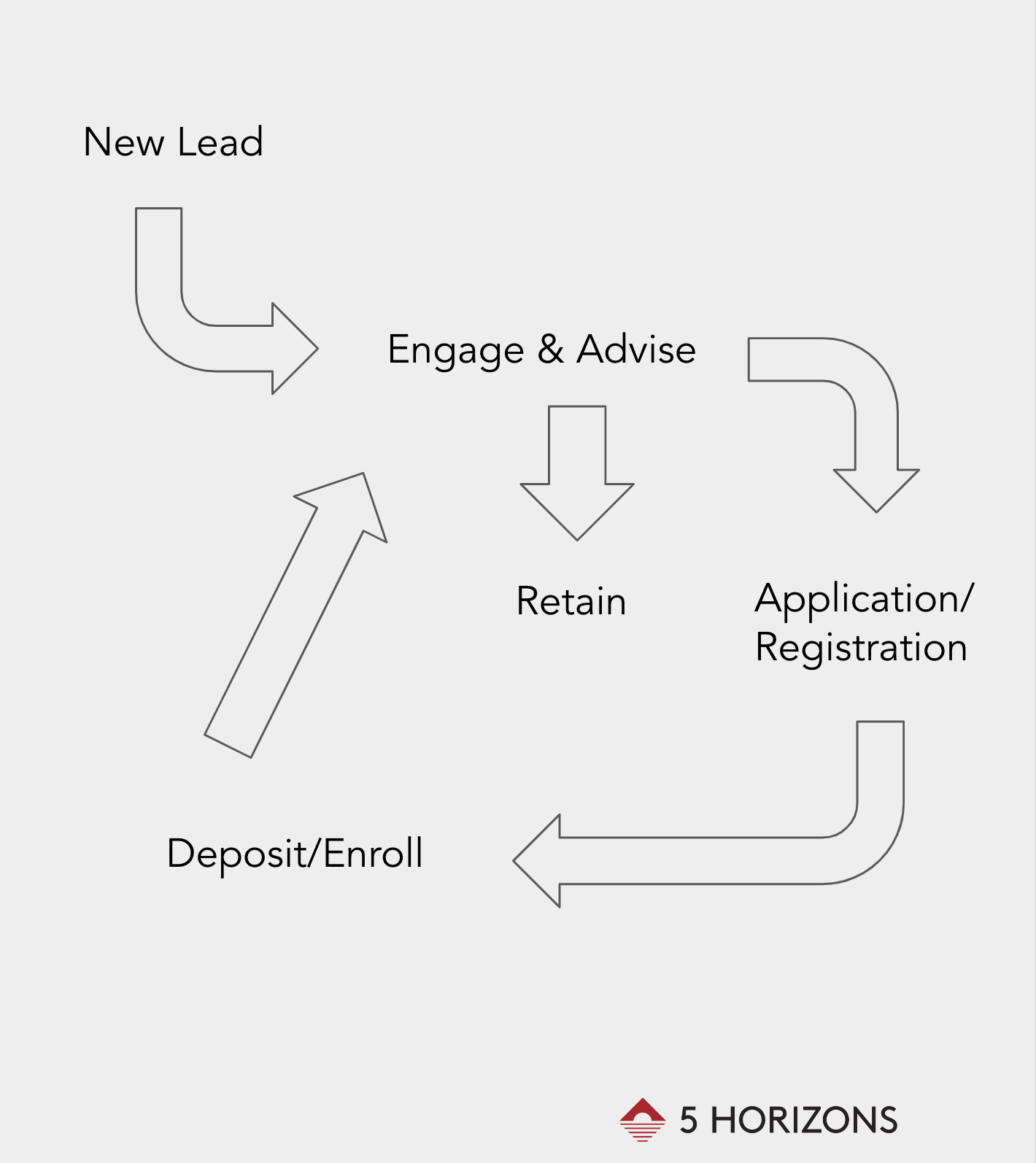
Break down the enrollment process in order to understand what’s working and what can be improved upon. The breakdown we recommend utilizing splits the process into five concrete elements:

  • Lead to Application Rate
  • Lead to Registration Rate
  • Deposit to Enroll Rate
  • Retention Rate (Fall-to-Spring & Spring-to-Fall)
  • Share of Stealth Applicants/Registrants

2. Build a Model

Imagine your ideal sales process. Writing it down or illustrating it can serve as a springboard for creating a direct response marketing strategy. Here’s a model we recommend:

3. Identify Key Performance Indicators (KPIs)

Key performance indicators (KPIs) are targets that help you measure progress against your strategic objectives. KPIs are essential targets for the success of your enrollment results. Each stage in your enrollment marketing must have: 

  • % Lead to Registration Rate
  • % Fall-to-Spring Retention Rate
  • % Spring-to-Fall Retention Rate

4. Address Each Stage of Your Enrollment Model

If necessary, make improvements to each stage of your ideal model. Here are a few examples of common issues we’ve encountered in enrollment models:

Lead-to-Enroll Rate Too Low

Our Solution: Improve lead quality and outreach. Ask yourself which lead sources are getting to advanced stages in the enrollment model and which are not. Focus your efforts on the audience that needs the most assistance.

Retention Rates Below Benchmark

Our Solution: Add touch points to advising. Ask yourself how your team is communicating with students at different points in their journey. Are they receiving the appropriate support at each stage in order to move forward? Consider expanding your advising plan for current students and filling in any gaps that may be missing.

Bottom Line

Direct response marketing can be a profitable strategy to increase enrollment but can take time to implement. As experts in higher education marketing, the 5 Horizons team brings outstanding results to universities and community colleges across the East Coast. Contact us for help with establishing a direct response marketing strategy for your institution and increasing enrollment. 

SEO Strategies That Make a Big Impact

SEO Strategies That Make a Big Impact

Your new all-in-one guide for higher page ranking and better user experience––plus download our free reference guide!


SEO. Search Engine Optimization. By now, we’ve all heard about it, no matter how big or small of a role marketing plays in our lives. We know that SEO is the process of improving a site to increase its visibility when people search for products or services related to your organization in Google, Bing, and other search engines. But, if you find yourself knowing what SEO is and what it does but are unsure of how to implement it in your website, read on.

How to Improve Your SEO

1. Identify Focus Keywords

A keyword is a word or phrase that serves as the primary purpose of the page. All pages should be written for one identified keyword, even though they can rank for more than one focus keyword or keyword phrase.

Our Recommendation

Keep track of the focus keywords used on your site and identify specific, different keywords for each page to avoid cannibalizing your page rankings.

2. Increase the Keyword Visibility

Identifying your keywords isn’t enough—the frequency with which a keyword is mentioned on a page plays a crucial role in improving your site’s ranking.

Our Recommendation

Place the keyword in the meta title, page headings, and three to five times within the content if it’s possible to do so organically.

3. Come up with a Relevant Meta Title

Meta title is the page title that shows in the tab at the top of a browser screen. It is used in search engine page rankings, that’s why it’s important for it to have keywords and be to the point. 

Our Recommendation

Aim for a meta title of about 60 to 65 characters to avoid parts of your title getting automatically removed in the process known as truncation.

4. Write a Meta Description

Meta description explains what the page is about and is often used as the preview text on search engine results. Make sure to write a meta description for each of your pages because, if left blank, the search engine may pull in whatever copy it decides is relevant. The meta description is often disregarded by people because it isn’t utilized in determining ranking, however, it can directly affect user experience and decision to click the link. 

Our Recommendation

Meta descriptions should be unique, approximately 145-155 characters, and contain focus keywords when possible.

5. Get Creative with Title Tags

Title tags are heading and subheadings on the page that are identified with HTML title tags (e.g., <h1>, <h2>, <h3>). You should use them not only for the better content organization but also as opportunities for including keywords.

Our Recommendation

Use the <h1> tag only once per page, as the main headline. Include keywords in your subheading tags and use them to break up content for readability, as well as for listicles.

6. Generate Cluster Content

Cluster content refers to content pieces written specifically to drive traffic to web pages through internal links. The more interlinking you do, the better the placement in search engine results pages.

Our Recommendation

When generating cluster content, use the focus keyword as the internal link anchor text to build authority.

Bottom Line

We know the abundance of information surrounding SEO can be overwhelming at times, but updating your site in a timely manner while keeping the best SEO practices in mind can really make a big difference. At 5 Horizons, we love helping clients expand their audience reach. If your site’s SEO needs a little boost, let us know—we’d love to increase the awareness of services or products you offer.

Download our SEO Best Practices Quick Reference Guide here.

When Third-Party Cookies Become Obsolete

When Third-Party Cookies Become Obsolete

3 Strategies for Advertisers to Use in the Post-Cookies World


Digital advertisers and marketers have used the “cookie” technology since 1995, within a year of its creation. However, the world of digital advertising as we know it is about to change. McKinsey & Company reports that starting in mid-2023, Google’s Chrome browser is expected to block third-party cookies, which are already blocked in Safari and Firefox. Since Chrome is the leading browser in large parts of the world, this policy will directly result in a drastically changed digital landscape, putting an end to cookie-based advertising.

As we head into the new year, now is the time to learn, adapt, and prepare your marketing strategy.

Mixing the Cookie Dough

Cookies are small pieces of code added to users’ web browsers as they visit different websites. This code remembers the users’ previous actions and settings (e.g., location, search history, items you put in your cart, etc.) and uses this information to deliver a more tailored web browsing experience. Advertisers utilize cookies to collect user data that ultimately helps them deliver the most relevant and targeted content to specific audiences.

Cut Out the Cookies

Get a head-start in refreshing your advertising strategy by implementing these three strategies.

1. Use Consumer Points to Collect First-Party Data

First-party data refers to data that is collected passively, meaning with the users’ consent but without their direct participation. Browsing behavior, content consumption, location, device, and time of day are all examples of first-party data. 

Your business, brand, or educational institution should intensify efforts to collect data at the consumer touchpoints you control, such as your own websites, and use analytics to fill in the blanks where the data sets are incomplete. If you require information about a user’s intentions, preferences, and lifestyle, you can convince users to identify themselves and share this kind of information, called zero-party data, by giving them something valuable in exchange.

2. Create Partnerships to Leverage Second-Party Data 

Since first-party data is not enough to achieve broad reach goals, marketers can build partnerships with other companies to exchange data that users have cleared for certain purposes. Such partnerships are most effective in maximizing the value of data when both parties pursue similar interests but aren’t direct competitors.

3. Learn Contextual Advertising & Interest-Based Targeting

Contextual Advertising

While cookie-driven approaches display ads based on a user’s browsing history and inferred interest, contextual advertising is based on the current content a user is viewing. New contextual targeting tools rely on natural language processing and image recognition, allowing algorithms to understand the context of web pages and apps. This enables marketers to display ads in an environment that is both highly relevant for their potential customers and safe for their brands.

Internet-Based Targeting

A new approach promoted by Google as an alternative to cookie-based targeting, internet-based targeting uses Google Topics. The idea behind this allegedly more private tool is that a browser learns about users’ interests as they surf the web and shares their top interests with participating websites for advertising purposes. When a user visits a website that supports the Topics API, the browser will choose up to three topics on their device from their most frequent ones (one for each of the last three weeks). The website and its advertising partners can then use these topics to determine which ads to display.

Baked to Perfection

Cookies or not, 5 Horizons always strives for perfection and knows how to capture unique leads for your business or institution. With over 9 years of expertise, we specialize in digital marketing and can assist with any of your advertising needs