How to Establish a Successful SEO Strategy

Over the course of our Demystifying Search Engine Optimization (SEO) blog series, we learned about the different steps you can take to improve your SEO efforts. If you’re still wondering what the best SEO strategy is for 2024 and beyond, here are the main takeaways from the series.

1. Make technical SEO a priority

In the abundance of content, it’s easy to shift your focus from the foundation of any successful SEO strategy—technical SEO. It’s integral for you to keep your website architecture, internal linking, structured data mockups, and site loading speeds in check, ensuring a positive user experience and readability for Googlebots.

2. Set concrete goals

A successful SEO strategy is personalized to your brand or organization, so consider asking yourself: what are my SEO goals for this year? From optimizing your on-page SEO to centering your efforts around local SEO, take the steps that will directly help you achieve your personalized goals rather than a broader definition of SEO success.

3. Stay on top of SEO trends

SEO strategy is a continuous journey. While today marketers are preoccupied with the role of Artificial Intelligence (AI) in SEO, tomorrow might bring a new trend that will make everyone pivot their SEO efforts. Keeping up with SEO updates and best practices is essential, as long as you also continue making evergreen SEO strides, such as producing high-quality content and working toward specific SEO goals (e.g., increasing return site visitors).


Remember: you don’t have to do everything all at once. The internet is full of numerous “musts” when it comes to SEO, that’s why it’s vital to hold awareness and curiosity when it comes to Search Engine Optimization. Consider implementing bite-sized steps toward improving your SEO strategy and come back to our Demystifying SEO series whenever you need a refresher on SEO basics. For more expert tips and exceptional SEO services, contact 5 Horizons today.


The Future of SEO: 2024 SEO Trends & Beyond

As our series on Search Engine Optimization (SEO) comes to an end, it’s important to look ahead. While SEO is constantly evolving and changing, here are the latest predictions on what might be on the horizon for SEO in 2024 and beyond.

1. Increased Emphasis on Artificial Intelligence (AI)

In our previous blog on how AI and SEO interact, we mentioned that AI is not going to take over SEO. However, AI’s influence on future SEO trends is undeniable. With predictive analysis getting further developed as a feature, AI can identify emerging trends and topics before they become mainstream. This would allow businesses to use AI not only for keyword research but also for content recommendations and generation, as AI gets trained to better identify the user intent behind each search. AI’s growing capabilities and accuracy would help businesses stay ahead of the popularity curve, producing unique content that can become relevant in the near future.

2. Changes in Search Result Layout

Expanding on the topic of AI, the use of AI-powered chatbots for search will likely continue to grow. With an increased use of software such as ChatGPT and Bing’s Copilot to perform searches, Google is continuously optimizing a chatbot of their own—Search Generative Experience (SGE). SGE lets users ask direct questions and displays results in a different format compared to the classic list we are accustomed to seeing on search engine results pages (SERPs). SGE presents results in complete sentences and provides users with examples, getting rid of the need to click through multiple links with information. 

This trend is a double-edged sword: on the one hand, brands who aren’t able to rank highly in SERPs now get a chance to have their content displayed on SGE; on the other hand, there’s an assumption that SGE will reduce organic traffic for many short-tailed keywords because users will be able to get a complete AI-generated answer as their search result. As Google rolls out SGE updates in the future, some businesses might consider adjusting their SEO strategies to account for AI chatbots.

3. The Reign of Zero-Click Searches and Featured Snippets

With SGE chatbot’s potential to disrupt the current list format of search results and Google continuously favoring quick how-to lists and direct, short answers to the users’ questions, businesses should start optimizing their content for featured snippets. Known as zero-click searches, this type of content appears in featured placements or “People Also Ask” section of SERPs, allowing users to find the information they were looking for without clicking on any external links. As harmful as they are to website traffic, featured snippets aren’t going anywhere, and we predict they will only keep getting expanded. For that reason, brands should aim to secure visibility in these prime search positions and provide concise, valuable information that satisfies user queries upfront.

4. Continuous Prioritizing of Search Intent Clusters

Over the last few years, SEO has been centering the individual search intent. With long-tailed keywords getting more traffic than short-tailed keywords, Google has been prioritizing search intent clusters—groups of related queries that indicate specific user intents or needs. Search results will continue getting hyper-personalized for consumers’ behaviors, preferences, and context. Moving forward, SEO strategies should hone in on thoroughly understanding each brand’s target audience and create highly tailored content and user experiences.

5. Augmented Reality (AR) and Visual Search Optimization

With AR technology on the rise, it’s only a matter of time before SEO practices will need to pivot and adapt. We expect that businesses will have to enhance their online presence by optimizing images and other visual content for search engines. Because Google crawlers notoriously need help understanding the content of each webpage, businesses will need to provide explicit clues about the meaning of their pages, the process known as implementing structured data markup. This step will become essential in providing context for AR experiences. Additionally, as Google has been optimizing its search results for voice assistants, the same approach may extend to visual queries, requiring SEO practitioners to consider factors such as image recognition and object detection.


If you’re wondering whether SEO is still relevant in 2024, rest assured that it is and will continue to stay so while adapting to shifting consumer needs. For businesses aiming to maintain online visibility and engagement, it’s vital to stay in tune with the changes in user behavior, especially when it comes to their target audience. By anticipating and promptly adapting to emerging trends and innovations, businesses can position themselves for success in 2024 and beyond. To further stand out amid the competitive digital marketing landscape, contact 5 Horizons to discuss how we can help bring your SEO strategy to a new level of excellence. You can also read the blogs in our Demystifying SEO series to better understand and learn the ins and outs of SEO.

How AI and SEO Interact

Artificial intelligence (AI) is here to stay, but what role does it play in Search Engine Optimization (SEO)? With Google recommending writing content for people and then optimizing it for search engines, what room is left for AI?

These questions are on the minds of many marketers and internet users, as AI has been changing our digital search landscape. Search results are now highly customized, as they’re being influenced by the user’s intent, past behaviors, devices, locations, and other factors. While the increasing popularity of generative AI such as Chat GPT or Google Bard has once again confirmed that SEO is an ongoing process, it’s crucial to keep up with the ways AI and SEO interact.

How do you use AI for SEO?

So, how does SEO work with AI? The best way to answer this question is to rephrase it and give yourself more agency: How can you use AI to improve your SEO strategy? This way, it becomes clear that AI is here to help you enhance your SEO efforts and not do them for you. For instance, instead of misguidedly prompting generative AI to write all of your content, consider incorporating the following alternative ways of using AI for SEO.

User Experience (UX) and Content Optimization

Since user experience is a priority when it comes to an SEO strategy, you can use AI to analyze user behavior and the type of content you publish. AI can then provide you with insight and suggestions on the areas that need improvement. Implementing this recommendation is a great way of using AI to make your content SEO-friendly and diversifying it to improve your UX, which will result in better SEO rankings.

Virtual Assistants Implementation

Both voice search assistants and chatbots can benefit your UX, but they go a step further. Chatbots are a form of AI that provides instant help to your website’s visitors, increasing customer satisfaction, return site visitors, and engagement rates.

With the popularity of AI voice assistants such as Amazon’s Alexa and Apple’s Siri, voice search inquiries have significantly increased. Since SEO is always evolving, it’s important to consider voice search when building your strategy. Optimizing your content using long-tailed keywords can be an essential step, as it accounts for users speaking in complete sentences when searching the web for content.

Keyword Research

AI tools can increase your productivity and SEO performance by finding, analyzing, and implementing keywords into your strategy. Semrush’s Keyword Magic Tool or Copilot can provide insights into keyword opportunities and adjustments, as well as suggestions for keywords to use in your content.

Is AI going to take over SEO?

The short answer is no, AI is not going to take over SEO. Even though generative AI offers an opportunity to create content that’s optimized for SEO, search engines still prioritize content that’s written for users. The human touch is essential to current SEO practices, even while AI continues to influence and change the SEO process.

Keeping this in mind, it’s important to acknowledge that AI has already substantially transformed SEO and digital marketing with predictive search, enhanced result accuracy, and a constant stream of information. Understanding AI’s continuous influence on SEO will provide businesses and organizations with a necessary competitive advantage.


Staying up-to-date on technological advancements and their impact on SEO is one of our many talents. Contact 5 Horizons today to discuss conducting an SEO audit to help your organization thrive, or follow our Demystifying SEO series to learn more.

Get to Know the Googlebot

If you work in digital marketing or have ever tried marketing your products or services, you have most likely heard one of the phrases “Google crawlers,” “Google spiders,” or “Googlebot.” But what exactly do they mean?

Google crawler (sometimes referred to as a spider) is a generic term for any program used to automatically discover and scan websites by following links from one web page to another. Googlebot is the main crawler used for Google Search.

What does a Googlebot do?

The data Googlebots find as they crawl from link to link gets stored in a collective index. This is the index that online search results get pulled from, which makes it one of the biggest reasons you should care about Google crawlers. Due to the nature of the Googlebot software, the way your website uses text links becomes significantly important. Streamlining the process that allows Googlebots to crawl from page to page will help your website rank accurately on the search engine result pages (SERPs). This means that a good Search Engine Optimization (SEO) strategy always keeps Google spiders in mind to help them easily digest your website’s relevant pages.

How many Googlebots are there?

While Google has 16 types of crawlers designed for various purposes, there are two most relevant types:

  • Googlebot Smartphone: a mobile crawler that simulates a user on a mobile device.
  • Googlebot Desktop: a desktop crawler that simulates a user on a desktop.

Both of these crawler types attempt to understand and experience websites the way humans do, which is why it’s vital to keep user experience in mind when optimizing your website.

How do you improve your website for Googlebots?

The main thing you need to do to optimize your website for Googlebots is making sure your image links, navbar, anchor text, and any other links are working properly. The easier it is for this software to sift through your content, the higher your website’s crawlability. 

When you can’t guarantee successful crawlability yourself, 5 Horizons can help. We make sure that the most important pages on your website do not get blocked, and that Googlebots have the most streamlined path of crawling your website through site maps, fresh content, and internal linking.


Here at 5 Horizons, we keep Google spiders in mind when building or helping you with your websites. Contact us today to learn more about our offerings.

Abstract arrow direction. Technology background

Demystifying SEO

A new blog series for understanding the ins and outs of SEO.


Search engine optimization (SEO) is the process and strategy of increasing search result visibility for businesses. With technology changing and evolving every day, SEO strategies are constantly in flux.

In our new series Demystifying SEO, our team is doing a deep dive into the complexities of SEO and how you can begin implementing best practices into your own marketing plan.

The Basics 

In the first section of the series, we’ll cover the basics:

How We Implement SEO

In the second section of the series, we’ll address the challenges surrounding SEO:

Where is SEO Going Next?

And in the third section of the series, we’ll cover where we think SEO is headed next:

Follow our Demystifying SEO series to learn how SEO is more than just content, how it requires a thorough strategy and involves intent-focused keyword research. Or contact us to discuss conducting an SEO audit to help your business thrive.

Magnifying Glass on white computer keyboard on white desktop with accessories.

Google’s Changes to FAQ and HowTo Results: What Website Owners Need to Know

As of September 2023, Google reduced the visibility of FAQ and HowTo information in its search results. If you haven’t seen the impact of this decision on your website’s traffic yet, here is everything digital marketers and website owners should know if considering rethinking their strategy.

FAQ Results

Google now limits the regular display of FAQ-rich results to well-known and authoritative websites, primarily in the government and health sectors. Google’s algorithm will determine which websites fall into these categories.

HowTo Results

Attempting to simplify search results, Google no longer shows HowTo rich results on desktop or mobile devices. For this reason, this search result type has significantly lost its value.

What Changes Do You Need to Make

If your site features structured data, you don’t have to proactively remove it. Though it has no visible effects in Google Search, it’s not going to cause any problems either. FAQ and HowTo Schema markup may also continue to be useful for other search engines, aiding in content indexing and rich result display in SERPs.

Impact on Website Traffic

Google doesn’t consider this global update a ranking change, so the effects of FAQ’s and HowTo’s reduced visibility remain to be fully felt. Most likely, the removal of these sections from SERPs will lead to more search results displayed on a single screen, increasing the competition for clicks. Website owners who currently employ FAQ and HowTo Schema markup should prepare for potential traffic fluctuations, which may vary based on context and the type of website you have. 

Staying up-to-date on Google’s updates and closely monitoring your website’s performance can help you effectively adapt to the evolving search result dynamics. And with 5 Horizons, you can always stay on top of digital marketing industry trends.

Indian business man wearing headset having virtual team meeting on video conference call using laptop work from home office talking to diverse people group in remote teamwork online distance chat.

Google Slides Presentation Tips

Giving a Google Slides Presentation in Google Meet, while still seeing your speaker notes and your audience, can be tricky. Our IT team has outlined the process to make your next presentation look professional and operate smoothly.

We recommend practicing these steps first before your actual presentation to make sure your technology is working properly.

1. Log into a Google Meet

At this time, you can adjust your visual layout to see the other attendees:

  1. Click on the three vertical dots, then “Change Layout.”
  2. Choose between Auto, Tiled, Spotlight, or Sidebar for how you want your layout to look. An Auto selection will allow your screen to adjust according to different attendees’ presentations.
  3. Use the Tile Slider to increase the number of attendee tiles you will see based on the size of your screen.

2. Present a Google Slides Presentation

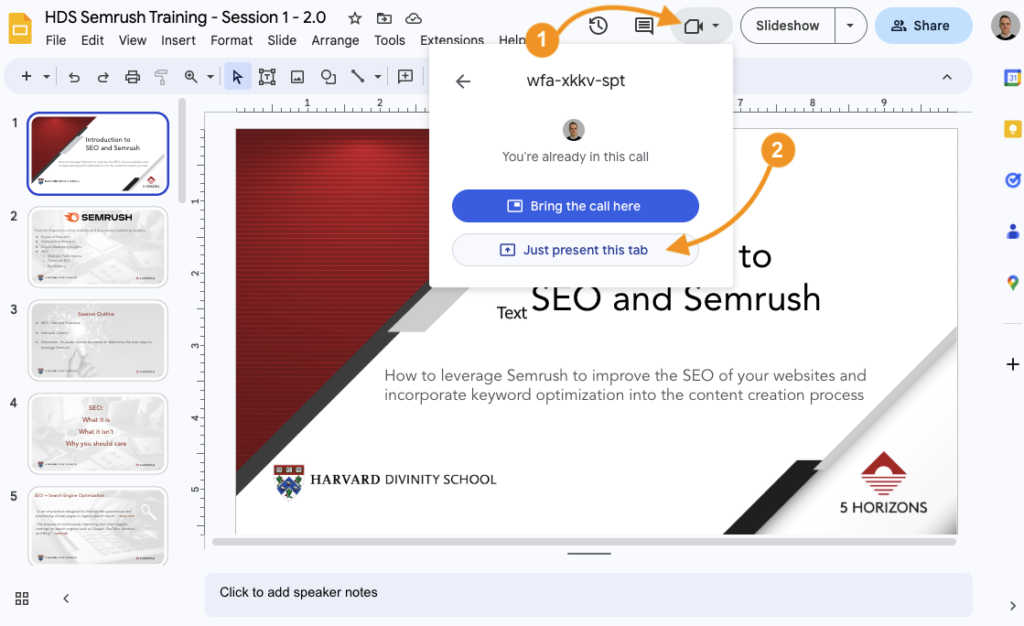
  1. Navigate to the Google Presentation and click on the Video Camera icon in the top right of the screen.
  2. Select “Just present this tab.”
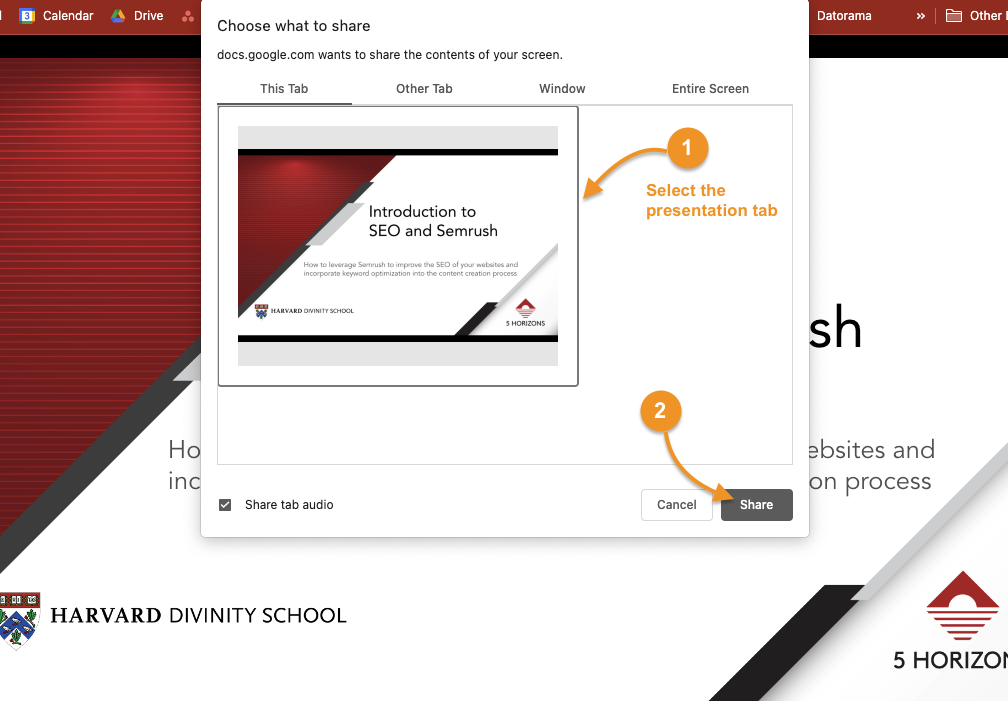
  1. Select the presentation under the “This Tab” heading.
  2. Click “Share.”

3. Present from Google Meet

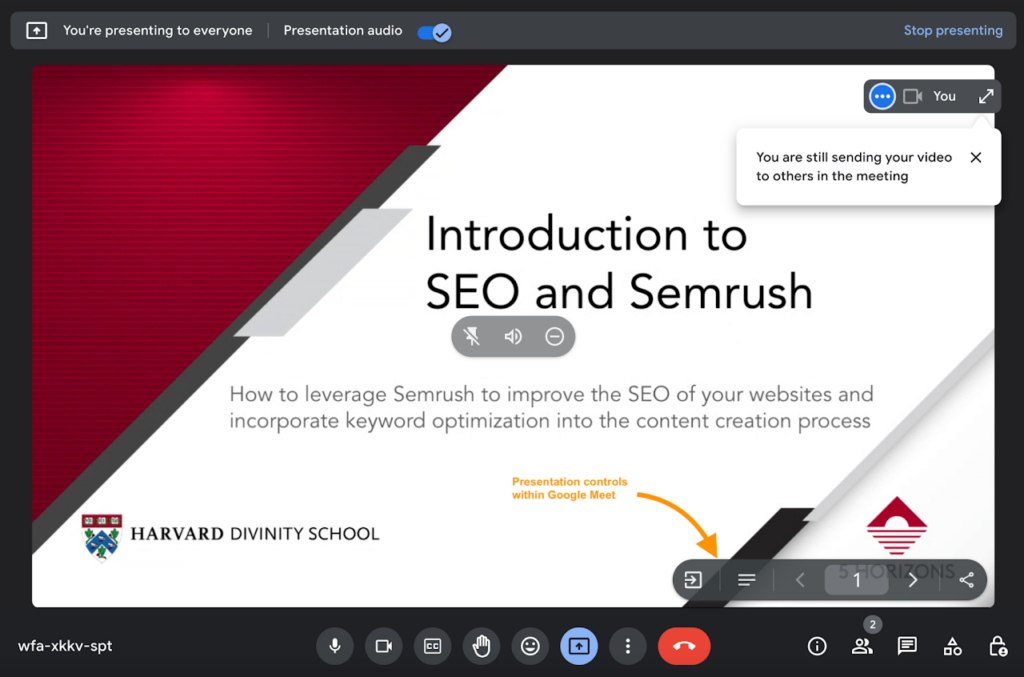
Presentation Controls

  1. Navigate back to the active Google Meet.
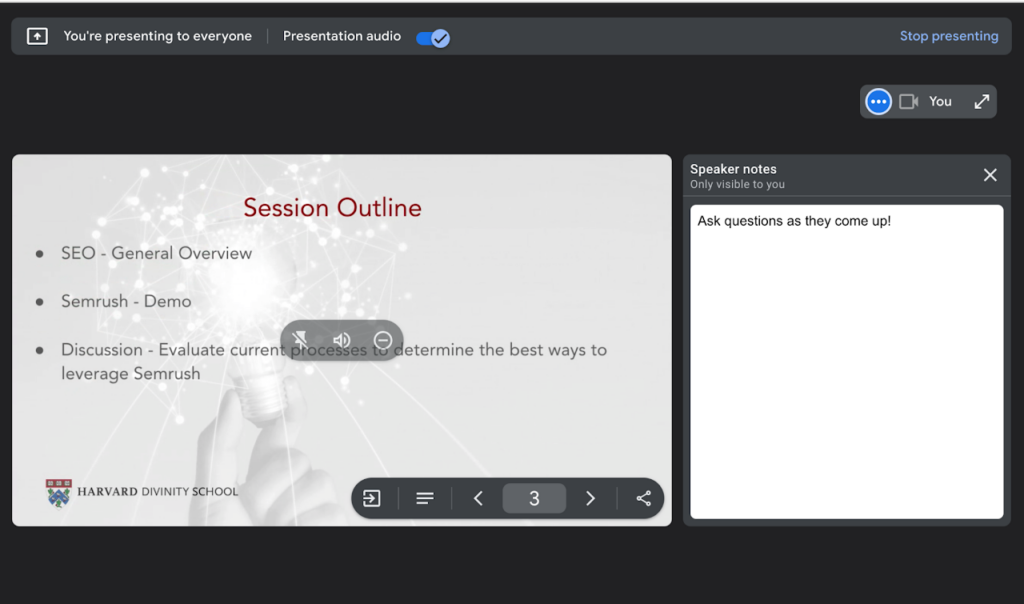
  2. The screen will now display your presentation and controls for you to conduct the meet directly in the Google Meet.

As you give your presentation, you can either use the forward and back (< >) icons in the Google Meet window to move through your deck, or you can navigate within the Google Slides Presentation window on your computer.

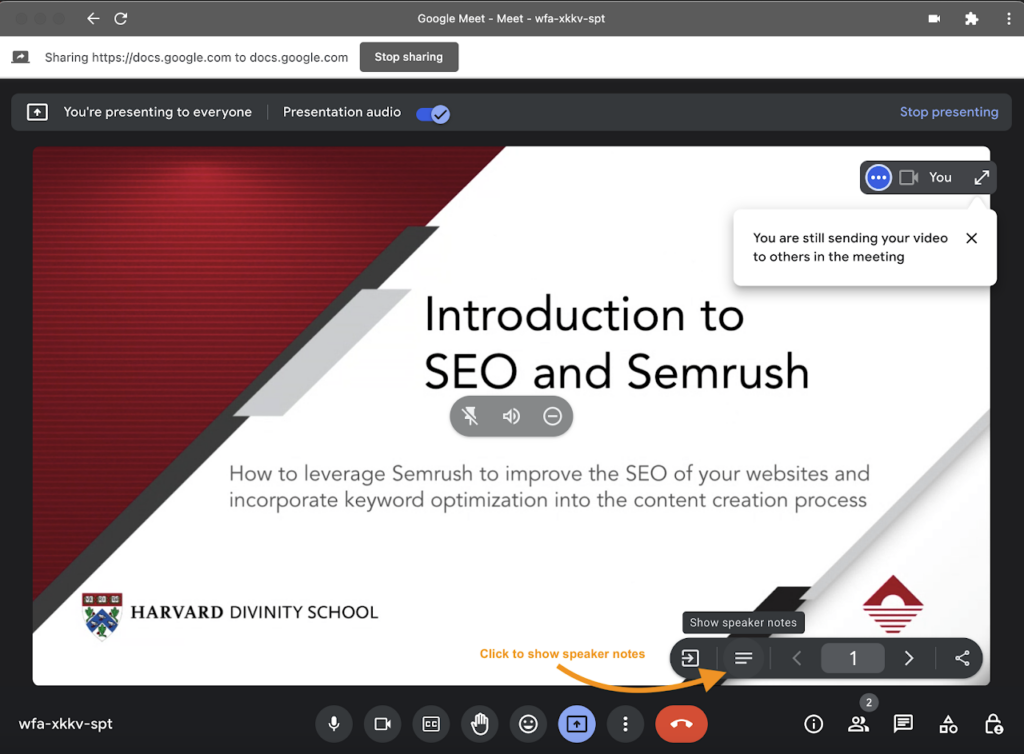
Speaker Notes

  • To view the speaker notes, click on the 3 horizontal lines icon to the left of the left arrow in the Presentation Controls.
  • Speaker notes will appear in the right column.