
What’s the Difference Between SEO and AI Search: AEO, GEO, and LLM SEO?
The world of online search can feel quite murky as new AI tools continue to emerge, and with them, new opportunities to optimize online content to boost your brand’s visibility. In the world of AI Search—Answer Engine Optimization, Generative Engine Optimization, Large Language Model SEO, and more—what do these terms really mean?
Before we dive in to the latest trends in search, let’s set a baseline.
Search Engine Optimization
Search Engine Optimization (SEO) is the practice of increasing the visibility of your website in Search Engine Results Pages, focusing on organic traffic. Explore our blog series, Demystifying SEO.
One element is technical work, like optimizing site architecture; using structured data and schema markup; and enhancing site security, speed, and mobile friendliness.
SEO strategies also include:
- Localization and on-page content: writing original, valued content
- Incorporating keywords
- Including clear and informative meta descriptions, title tags, and image alt text
SEO is ongoing work, and it isn’t going anywhere.
It’s hard to believe, but the term search engine optimization made its first appearance as early as 1997—even before Google’s launch the next year.
Nearly 30 years later, and with Google established as the benchmark search engine, SEO has grown into an entire industry of its own, with universally accepted standards and best practices.
While authorities have been examining how AI and SEO intersect for a while (we wrote about the topic in 2024), it’s only been about four years since the explosion of ChatGPT usage and other subsequent AI tools. It’s no wonder that in such a short time and with rapidly evolving tools, so much in the new world of AI-powered search continues to be in flux.
Even among experts, a singular definition of the newer search terms hasn’t been agreed upon. With that in mind, let’s explore some commonly used phrases and how you might approach each of them.
Answer Engine Optimization
Answer Engine Optimization (AEO) is “the practice of structuring and formatting content so AI-powered tools like ChatGPT, Perplexity, Google AI Overviews, and voice assistants can easily understand, trust, and cite it as direct answers to user queries,” according to Profound, an enterprise analytics platform.
Think of AEO as a distinct strategy of crafting direct, concise answers to search queries in order to appear in Google AI Overviews, featured snippets, and voice assistants like Siri or Alexa.
Tactics include:
- Clear headings
- Short paragraphs
- Definitive Q&As
- Bulleted lists
- Content that users can quickly understand and that will fully answer their search query
Generative Engine Optimization
Generative Engine Optimization (GEO) is a bit broader than AEO. According to Search Engine Land, “GEO is the practice of structuring your content and digital presence so that AI-powered search platforms — including ChatGPT, Google AI Overviews, Perplexity, Claude, and Copilot — can retrieve, cite, and recommend your brand when answering user questions.”
While AEO focuses on concise answers to specific questions, GEO is all about being part of a larger response. The AI tool does just as the name suggests: generates an answer to a query by synthesizing information from multiple sources, rather than quoting directly from one brand’s existing content. A portion of your content may be combined with information from another source. To be included in AI summaries (like the AI overview on Search Engine Results Pages), your content should be longer, more in-depth, and in multiple locations across the web.
Tactics include:
- Developing unique perspectives
- Original data
- Deep expertise
- Easy-to-read document structures
- Using statistics and expert quotes
Large Language Model SEO
Large Language Model SEO (LLM SEO) is generally thought of as optimizing content to be mentioned in conversational standalone systems, like ChatGPT, Gemini, Claude, and Perplexity.
These AI tools source from the entire web for their responses, so the best tactic is to build strong brand authority, including content both on your own site and on others. Being mentioned by trusted external sources and exhibiting strong E-E-A-T signals can boost your brand’s likeliness of surfacing in conversational AI tools.
What Is E-E-A-T?
An acronym used by Google that stands for Experience, Expertise, Authoritativeness, and Trustworthiness.
Experience: Include personal, first-hand experience with your product or service.
Expertise: Establish your knowledge, skills, and credentials. Tell the reader why they can trust you on this topic.
Authoritativeness: Awards and others linking to or quoting your content confirms for AI that you are an authority.
Trustworthiness: Reviews, quotes, and testimonials from real users establish your brand as trustworthy.
It’s worth noting that some experts, like Neil Patel, co-founder of NP Digital and a leading SEO expert, contend that there’s a nuanced difference between LLM SEO and Large Language Model Optimization (LLMO). Patel argues that LLM SEO optimizes content to make it easy for search-based AI tools, like Google’s AI Overviews and ChatGPT. LLMO increases your overall visibility in AI tools, including those that aren’t specifically search-based, like Claude and Gemini.
I’m Overwhelmed. Where Do I Start?
With experts in the field having varied opinions on some of these new acronyms and terms, it can feel a bit fuzzy and hard to follow. But the good news is that foundational SEO isn’t going anywhere.
In fact, Google itself shared that SEO best practices are the exact same techniques that work to optimize content for AI tools. Google’s stated perspective is that each of these new terms or approaches do fall under the scope of SEO: “Optimizing for generative AI search is optimizing for the search experience, and thus still SEO.”
However, if you prefer some distinction, here’s a breakdown of how you could think about each of the strategies. But remember: whether you think of AEO, GEO, and LLM SEO as additional, unique approaches, or rather expansions of your existing SEO work, the goal of all of these strategies is to make your brand more visible online.
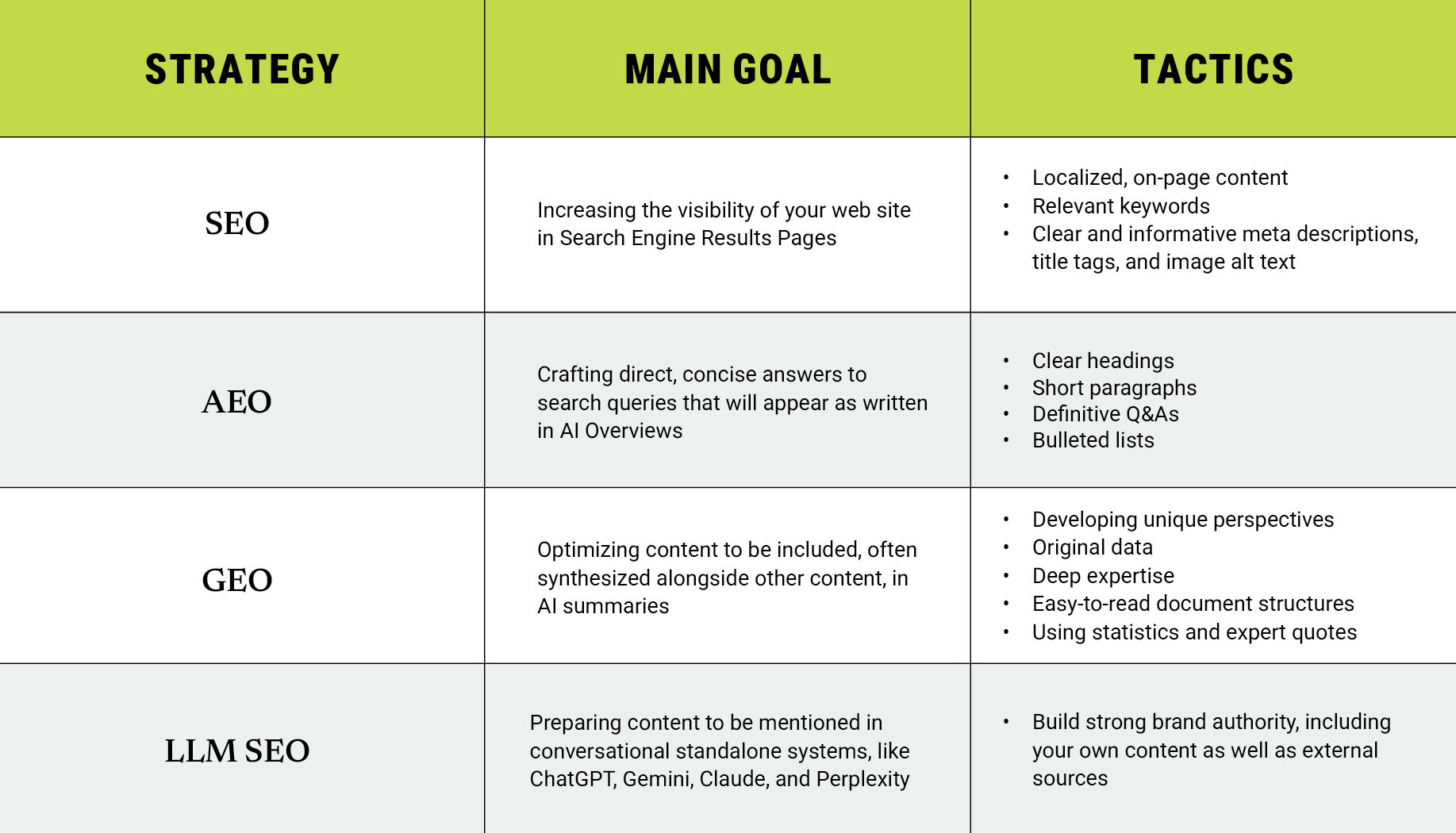
The internet is getting smarter, which means there are more places and more ways to be found. This is both an opportunity and a challenge. The tactics we described here for each optimization strategy can all be combined. If you tackle one or two concrete tactics in any category, think of it as a win for your overall visibility.
And if you feel ready to create a full visibility strategy that implements SEO, AEO, GEO, and LLM SEO, get in touch with 5 Horizons. Our expert team is ready to help.
Sources
Profound: What is answer engine optimization (AEO)? Understanding AEO for the future of search
Search Engine Land: Mastering generative engine optimization in 2026