Summer Social Media Ideas for Higher Education Institutions

With students being away for the summer and the campus looking empty, higher education social media managers often struggle to come up with content ideas to keep their accounts active. Though the overall online engagement drops in the summer, there are still ways of curating lively feeds and encouraging student and alumni engagement.

If you find yourself short on inspiration, here are our summer social media ideas for higher ed marketers:

1. Student or Alumni Features

Whether it’s photos from eye-catching vacations, study-abroad experiences, internships, jobs, or alumni meet-ups (with bonus points if people are wearing your school’s colors), featuring familiar faces on your social media channels can make your community feel more connected during the summer break.

2. Campus Highlights

The students might be gone, but the natural beauty of your campus is most likely just as vibrant. With lush green trees and flowers in bloom, summer is the perfect time to show off the unique natural features of your campus, reminding your online audience of how welcoming it is.

3. Get the Students Involved

Students want to have a say in what their campus life is going to look like in the new academic year. By creating polls or contests surrounding event planning or artistic programming, you can encourage audience participation and engagement in a manner that’s fun for students and insightful for you as a higher ed marketer. This approach will help you identify ahead of time which programs or events the students are most excited about, giving you plenty of time to come up with the best promotional strategy.

4. Use the People Around You

Though most campuses look rather empty in the summer months, some schools still offer summer classes and host volunteer groups and sports teams. Use this time to create “behind the scenes” content featuring student athletes, tips on staying involved on campus between semesters, and staff highlights (important people for incoming and transfer students to know, such as academic advisors, and international student and student activities coordinators, among others).

5. Viral Trends

Though school life slows down in the summer, the internet does not. Trends will continue to emerge and cycle throughout the summer months, and you should be able to stay on top of the ones that align with the type of content your school usually publishes. With limited resources, summer trends are a good test of creativity for marketers and social media managers.

6. Facilitate Back-To-School Excitement

This idea is better suited for later summer months, when you can start creating content that generates anticipation for the upcoming semester. Create a hashtag new students can use to share their acceptance letters, and feature some of them on the school’s social media accounts. As the students prepare to return to campus, this is also a great time to show off how the staff gets the school ready for the Fall. Highlighting what students can look forward to in the new academic year is a great way of cultivating excitement and school spirit.


The summer months can also be used to evaluate your school’s social media presence, looking into statistics and taking note of what type of content performs best. Learning from those findings and taking inspiration from the ideas above can result in a summer full of engagement!

At 5 Horizons, we are experts in higher education marketing. Contact us today for extra social media insights or advertising assistance.


An overhead view of a man typing on his laptop, a gold watch on his left wrist. A notebook and pen open to his left with blank pages.

Best Practices for Creating Effective Content Posts

Optimizing your web pages for specific keywords can increase page ranking and boost traffic, but it may not be enough to achieve your goals. Strategically written content pieces can help improve keyword visibility through internal links to the page.

At 5 Horizons, we recommend a hub-and-spoke model where content includes links to other pages on the site. This strategy should also include planning for links between content pieces to provide authority and keep visitors on the site for as long as possible.

Start with a Content Strategy

A good content strategy will follow a site audit for keyword ranking and visibility. Questions to ask in a formal or informal audit include:

  • What keywords is the site already ranking for?
  • What is the search volume for those keywords?
  • What is the search volume for related keywords?
  • What topics and questions show up for “people also search”?
  • What are the most important pages on the site for organic traffic to find?
  • Where is the most potential for increasing page ranking?

These answers will help you identify target keywords, create a list of topics that can attract searches for those keywords, and map out page links. 

Create a Strong Foundation

While the actual content is quite important, there are several considerations that will make a big difference for the search engines.

Write Meta Titles That Matter

Meta titles should be limited to approximately 65 characters. This may require abbreviating the company or organization name, which is often acceptable since incorporating the keyword phrase into the supporting content is more important.

Create Compelling Meta Descriptions 

The meta description is most often used as the text that appears on the search engine results page. These should be approximately 145-155 characters and contain at least one instance of the keyword or keyword phrase. Be sure to include compelling content that encourages users to click the link. If your page is missing a meta description, the search engine may grab text from the webpage that isn’t relevant, resulting in fewer clicks to your site.

Remember to Write for the Bots and for the Humans

Search engines may determine how to rank web pages, but it’s ultimately the human readers who will or won’t engage. Therefore, the content needs to be keyword-rich without simply being keyword-stuffed. It needs to be interesting, well-written, and easy to scan. Use headlines (h2s and h3s) to guide readers (and the bots) through the piece. Bulleted or numbered lists also aid in content consumption.

Say What Needs to Be Said

You will find plenty of recommendations about how long a content piece should be for maximizing ranking. The most important consideration in writing content is saying what needs to be said in the number of words it takes to do so. Too short and your reader won’t find what they’re looking for; too long and they won’t bother sticking around to find out.

General Recommendations and When to Split Up

Each content piece should be approximately 500 to 750 words and include at least three to five mentions of the relevant keyword(s). The emphasis should be on providing interesting content that appropriately addresses the keyword topic. If this greatly exceeds the recommended length, consider breaking into multiple pieces of content and linking between them. 

H1s Get to Be Unique

Include the keyword in the main on-page title (h1). There should be only one h1 per page, and it should be unique within your site.

Provide Guideposts

Subheadings (h2) provide other opportunities for including the keyword or other variations and also guide readers through the content, whether they are skimming or searching for relevant information. We have provided multiple keywords for each content idea, and these should be included as h2s and/or within the content when it is easy to do so while maintaining readability. Preference should be given to keywords with higher search volume.

Include Variety and Avoid Cannibalization

Frequently, the difference between identified keywords and search volume is a matter of semantics and the monthly search volume may vary widely between phrases that appear quite similar. This is why we recommend including varied iterations within the content.

At the same time, it’s important to avoid cannibalizing rankings of other pages on the site by creating content pieces that overlap too closely or use too-similar keywords. If there isn’t enough differentiated content for a stand-alone post, consider using the related keywords as h2s within the larger piece.

Use Links to Drive Traffic

Use internal links on the keyword or keyword phrase to direct to the relevant website page. Links can also connect pieces of content to drive authority for those individual posts and for the site as a whole. Each content piece should have two or three links to other pages on the website.

Encourage Engagement with Strong Calls to Action (CTAs)

Each piece should end with a clear, prominent call to action (CTA) that ties back to the purpose of your site. This could be learn more, apply now, or another relevant action. 

Get In Touch

Questions about your recent audit? Coming up blank on content ideas? Ready to review your site? Reach out. We’re happy to help.

How to Build a Direct Response Enrollment Marketing Strategy

How to Build a Direct Response Enrollment Marketing Strategy

Presented at the National Council for Marketing & Public Relations (NCMPR) D1 Conference in Fall 2022


In October 2022, our team traveled to New York for the NCMPR D1 Conference and shared our insights on building a direct response enrollment marketing strategy at community colleges.

Direct response marketing has proven to be particularly effective for higher education. We compiled our top tips on how you can enhance your strategy, increase lead generation, and optimize lead progression.

1. Know Your Data

Break down the enrollment process in order to understand what’s working and what can be improved upon. The breakdown we recommend utilizing splits the process into five concrete elements:

  • Lead to Application Rate
  • Lead to Registration Rate
  • Deposit to Enroll Rate
  • Retention Rate (Fall-to-Spring & Spring-to-Fall)
  • Share of Stealth Applicants/Registrants

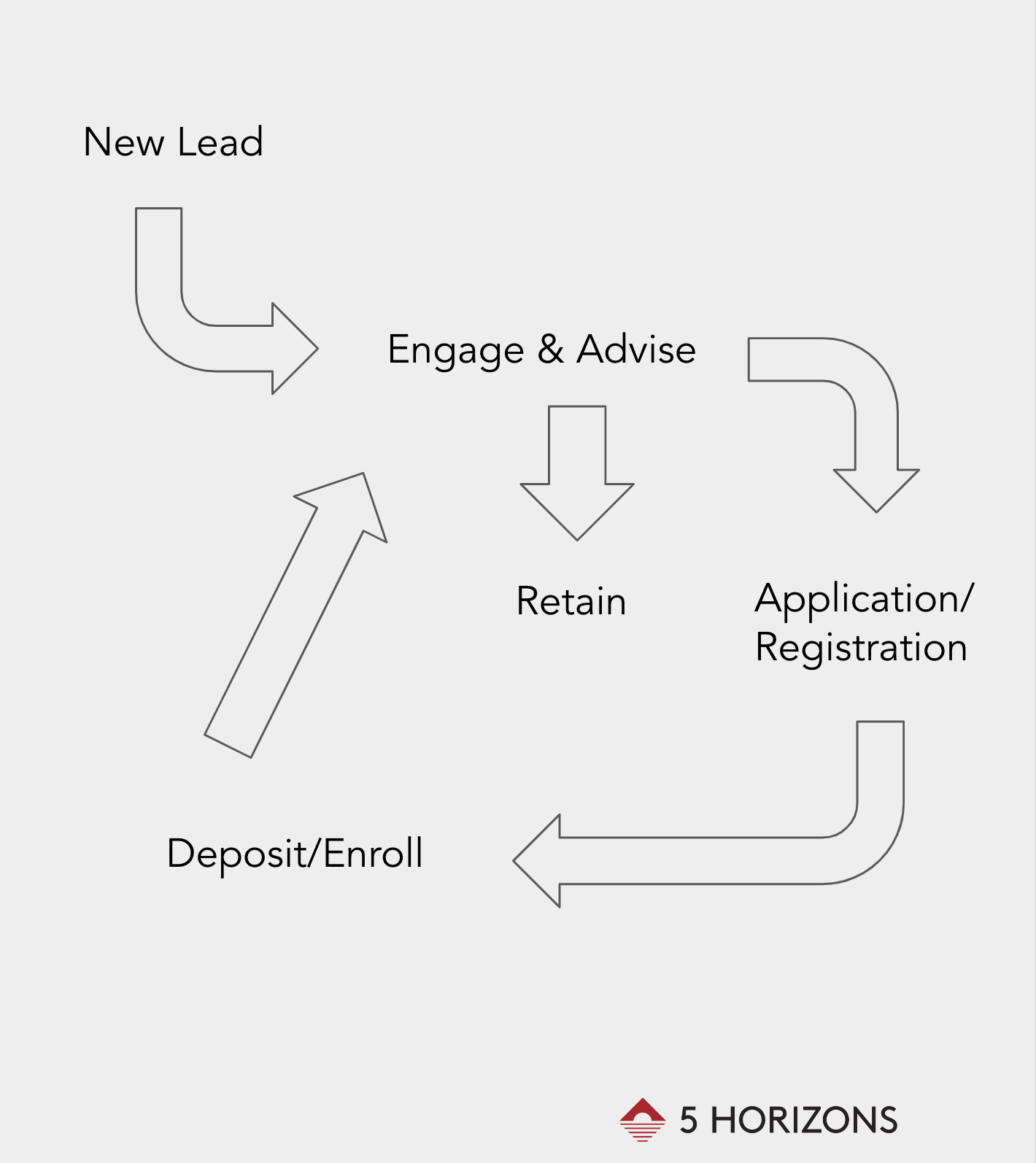
2. Build a Model

Imagine your ideal sales process. Writing it down or illustrating it can serve as a springboard for creating a direct response marketing strategy. Here’s a model we recommend:

3. Identify Key Performance Indicators (KPIs)

Key performance indicators (KPIs) are targets that help you measure progress against your strategic objectives. KPIs are essential targets for the success of your enrollment results. Each stage in your enrollment marketing must have: 

  • % Lead to Registration Rate
  • % Fall-to-Spring Retention Rate
  • % Spring-to-Fall Retention Rate

4. Address Each Stage of Your Enrollment Model

If necessary, make improvements to each stage of your ideal model. Here are a few examples of common issues we’ve encountered in enrollment models:

Lead-to-Enroll Rate Too Low

Our Solution: Improve lead quality and outreach. Ask yourself which lead sources are getting to advanced stages in the enrollment model and which are not. Focus your efforts on the audience that needs the most assistance.

Retention Rates Below Benchmark

Our Solution: Add touch points to advising. Ask yourself how your team is communicating with students at different points in their journey. Are they receiving the appropriate support at each stage in order to move forward? Consider expanding your advising plan for current students and filling in any gaps that may be missing.

Bottom Line

Direct response marketing can be a profitable strategy to increase enrollment but can take time to implement. As experts in higher education marketing, the 5 Horizons team brings outstanding results to universities and community colleges across the East Coast. Contact us for help with establishing a direct response marketing strategy for your institution and increasing enrollment. 

How to Strengthen Higher Education Marketing

How to Strengthen Higher Education Marketing: Part 1

Top Higher Education Marketing Trends to Implement in Your Strategy for 2023


Higher education marketing can often be a challenge for some institutions. With certain trends lasting one week and others staying relevant for months, it is not always clear how your school can stand out from competitors.

As experts in higher ed marketing, we compiled a rundown of the marketing trends and recommendations on how you can enhance your strategy in the upcoming calendar year. 

Crowdsourcing

Gen Z—a common target audience for higher education—has been relying on crowdsourcing for their decision-making, no matter how big or small. In the past few years, Gen Z has been looking up to influencers, peers, and online reviewers for advice and guidance. 

Crowdsourcing is the practice of turning to others for knowledge, goods, or services. Although the term “crowdsourcing” has been floating around since 2006, this practice became popular at the beginning of the COVID-19 pandemic and has continued to grow since, directly influencing digital marketing strategies. 

In 2023, higher education institutions should prioritize conversational marketing that captures the voice of Gen Z.

Our Recommendation

Student ambassadors are crucial in increasing enrollment as they help foster a sense of belonging for prospective students. Since human connections and interactivity will continue to dominate the marketing trends, developing an admissions ambassador program can add vital interpersonal value to your school’s marketing strategy. Through an ambassador, prospective students and their families are able to not only learn firsthand about your institution but also to establish mutual trust with the school.

Short-Form Video Content Creation

Whether your educational institution targets Gen Z, millennials, or Gen X, the reality of marketing trends for 2023 is the same: the pressure for content creation is not going anywhere. If anything, the popularity of short-form vertical video content continues to grow, with algorithms of social media platforms such as Instagram favoring reels over regular posts. 

For higher education, this means that social media marketing (SMM) is a powerful strategy to lean on for reaching broad audiences. 

Video content is an excellent way to engage with prospective students and showcase your campus and/or community that make your educational institution unique.

Our Recommendation

Short-form videos with people in them perform particularly well on social media and should be the focus of your school’s content creation. Whether it’s a montage of student photographs from the first week of classes or a day on campus from an admissions ambassador’s POV, such videos are likely to engage students and increase their interest in your institution. 

Another important thing to remember is that if your video has sound (e.g., a Q&A about the school), you should always incorporate closed captioning, since the majority of people scroll through videos without sound.

Make Your Institution Stand Out

5 Horizons can help incorporate all of these tips and more into your higher education marketing strategy. With our vast experience working with community college and university clients, the 5 Horizons team understands your unique target audience and provides exceptional creative execution and data insights that bring in tangible enrollment results. Let us help you reach and exceed your marketing goals.

Check out Part 2 of How to Strengthen Higher Education Marketing.

COVID Changed Higher Education Overnight

How 5HD Helped a Titan of Graduate Education Adapt to the New Normal

COVID-19 brought monumental challenges to the higher education sector. As campuses and universities shut their doors and sent their communities home, a fervent need for exclusively digital communication quickly arose. Our client, the Harvard Graduate School of Education (HGSE), faced an uphill battle into unknown territory: online learning. Well versed in online learning, the 5HD team was not only immediately available, but also well-prepared to assist HGSE with pivoting their business model and successfully reaching their admissions goals for the upcoming academic year.

Continue reading “COVID Changed Higher Education Overnight”