
What’s the Difference Between SEO and AI Search: AEO, GEO, and LLM SEO?

The world of online search can feel quite murky as new AI tools continue to emerge, and with them, new opportunities to optimize online content to boost your brand’s visibility. In the world of AI Search—Answer Engine Optimization, Generative Engine Optimization, Large Language Model SEO, and more—what do these terms really mean?

Before we dive in to the latest trends in search, let’s set a baseline.

Search Engine Optimization

Search Engine Optimization (SEO) is the practice of increasing the visibility of your website in Search Engine Results Pages, focusing on organic traffic. Explore our blog series, Demystifying SEO.

One element is technical work, like optimizing site architecture; using structured data and schema markup; and enhancing site security, speed, and mobile friendliness.

SEO strategies also include:

  • Localization and on-page content: writing original, valued content
  • Incorporating keywords
  • Including clear and informative meta descriptions, title tags, and image alt text

SEO is ongoing work, and it isn’t going anywhere.

It’s hard to believe, but the term search engine optimization made its first appearance as early as 1997—even before Google’s launch the next year.

Nearly 30 years later, and with Google established as the benchmark search engine, SEO has grown into an entire industry of its own, with universally accepted standards and best practices.

While authorities have been examining how AI and SEO intersect for a while (we wrote about the topic in 2024), it’s only been about four years since the explosion of ChatGPT usage and other subsequent AI tools. It’s no wonder that in such a short time and with rapidly evolving tools, so much in the new world of AI-powered search continues to be in flux.

Even among experts, a singular definition of the newer search terms hasn’t been agreed upon. With that in mind, let’s explore some commonly used phrases and how you might approach each of them.

Answer Engine Optimization

Answer Engine Optimization (AEO) is “the practice of structuring and formatting content so AI-powered tools like ChatGPT, Perplexity, Google AI Overviews, and voice assistants can easily understand, trust, and cite it as direct answers to user queries,” according to Profound, an enterprise analytics platform.

Think of AEO as a distinct strategy of crafting direct, concise answers to search queries in order to appear in Google AI Overviews, featured snippets, and voice assistants like Siri or Alexa.

Tactics include:

  • Clear headings
  • Short paragraphs
  • Definitive Q&As
  • Bulleted lists
  • Content that users can quickly understand and that will fully answer their search query

Generative Engine Optimization

Generative Engine Optimization (GEO) is a bit broader than AEO. According to Search Engine Land, “GEO is the practice of structuring your content and digital presence so that AI-powered search platforms — including ChatGPT, Google AI Overviews, Perplexity, Claude, and Copilot — can retrieve, cite, and recommend your brand when answering user questions.”

While AEO focuses on concise answers to specific questions, GEO is all about being part of a larger response. The AI tool does just as the name suggests: generates an answer to a query by synthesizing information from multiple sources, rather than quoting directly from one brand’s existing content. A portion of your content may be combined with information from another source. To be included in AI summaries (like the AI overview on Search Engine Results Pages), your content should be longer, more in-depth, and in multiple locations across the web.

Tactics include:

  • Developing unique perspectives
  • Original data
  • Deep expertise
  • Easy-to-read document structures
  • Using statistics and expert quotes

Large Language Model SEO

Large Language Model SEO (LLM SEO) is generally thought of as optimizing content to be mentioned in conversational standalone systems, like ChatGPT, Gemini, Claude, and Perplexity.

These AI tools source from the entire web for their responses, so the best tactic is to build strong brand authority, including content both on your own site and on others. Being mentioned by trusted external sources and exhibiting strong E-E-A-T signals can boost your brand’s likeliness of surfacing in conversational AI tools.

What Is E-E-A-T?
An acronym used by Google that stands for Experience, Expertise, Authoritativeness, and Trustworthiness.

Experience: Include personal, first-hand experience with your product or service.
Expertise: Establish your knowledge, skills, and credentials. Tell the reader why they can trust you on this topic.
Authoritativeness: Awards and others linking to or quoting your content confirms for AI that you are an authority.
Trustworthiness: Reviews, quotes, and testimonials from real users establish your brand as trustworthy.

It’s worth noting that some experts, like Neil Patel, co-founder of NP Digital and a leading SEO expert, contend that there’s a nuanced difference between LLM SEO and Large Language Model Optimization (LLMO). Patel argues that LLM SEO optimizes content to make it easy for search-based AI tools, like Google’s AI Overviews and ChatGPT. LLMO increases your overall visibility in AI tools, including those that aren’t specifically search-based, like Claude and Gemini.

I’m Overwhelmed. Where Do I Start?

With experts in the field having varied opinions on some of these new acronyms and terms, it can feel a bit fuzzy and hard to follow. But the good news is that foundational SEO isn’t going anywhere.

In fact, Google itself shared that SEO best practices are the exact same techniques that work to optimize content for AI tools. Google’s stated perspective is that each of these new terms or approaches do fall under the scope of SEO: “Optimizing for generative AI search is optimizing for the search experience, and thus still SEO.”

However, if you prefer some distinction, here’s a breakdown of how you could think about each of the strategies. But remember: whether you think of AEO, GEO, and LLM SEO as additional, unique approaches, or rather expansions of your existing SEO work, the goal of all of these strategies is to make your brand more visible online.
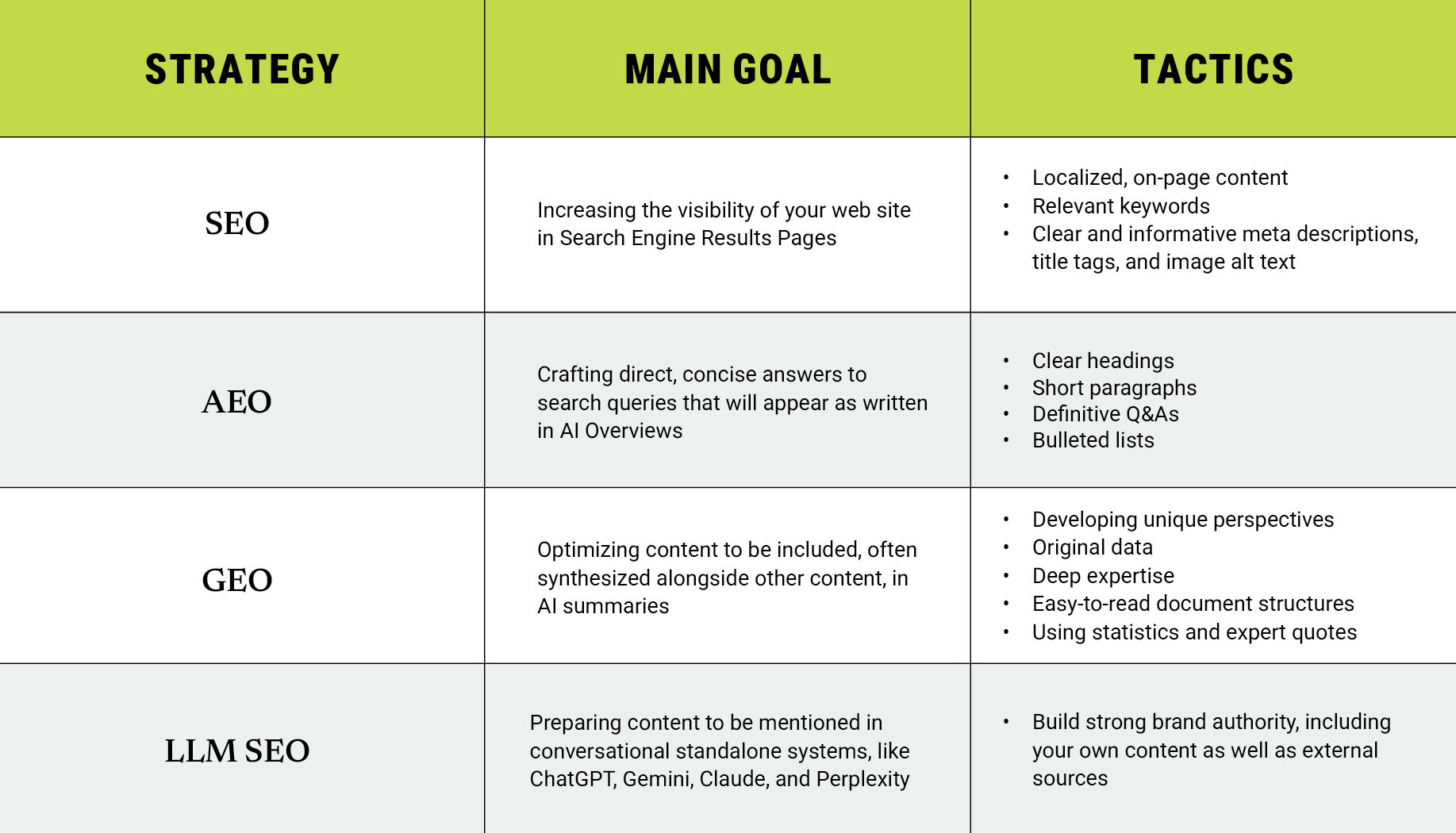
The internet is getting smarter, which means there are more places and more ways to be found. This is both an opportunity and a challenge. The tactics we described here for each optimization strategy can all be combined. If you tackle one or two concrete tactics in any category, think of it as a win for your overall visibility.

And if you feel ready to create a full visibility strategy that implements SEO, AEO, GEO, and LLM SEO, get in touch with 5 Horizons. Our expert team is ready to help.

Sources
Profound: What is answer engine optimization (AEO)? Understanding AEO for the future of search

Search Engine Land: Mastering generative engine optimization in 2026

Neil Patel: Large Language Model SEO (LLM SEO)

Google: Optimizing for generative AI

Aerial view of a college campus

10 Easy Wins for Higher Education Social Media Managers As Students Return to Campus

You’re a social media manager for a college or university, prepping your content calendar for the return-to-campus push. Drawing a blank this year? Here are 10 easy wins you can add to your schedule.

1. Simple Campus Tour

No need to film lots of B-roll and edit a roaming video (unless that’s your thing—we expect that would perform really well!). Showcase the ins and outs of your campus with a lighter touch by posting pictures of popular campus spots with fun “behind-the-scenes” captions. Rather than “here’s the library” (which is easy to find using a campus map), think more along the lines of: here’s the most-coveted study room in the library with the best views.

2. Highlight Campus Groups

New and returning students are guaranteed to be thinking about the activities they’ll join this year. You likely have content you’ve already written or posted about some of the popular campus groups, like a planning board, campus newspaper, or student government. Repackage your content into a new post to get students excited about the opportunities.

3. Campus Beauty

End of summer into the early fall on many college campuses is when that collegiate beauty really shines through. Take advantage of sunny afternoons, blooming flowers, and those special sights that make your campus stand out.

4. College Traditions

They’re unique to your school, and they unite the student body. Publish the fall Athletics schedule. Teach unique chants. Share the stats on your campus mascot. Share what meal is most popular in the dining hall—nugget night? Post any little tidbit you can think of that will help new students feel in-the-know, and remind the entire student body of the things that bring them together.

5. Throwback Pictures

Flip through old yearbooks for pictures of students moving in from years past. The fashion and hair are sure to generate engagement in the comments! It’s likely that the move-in and enrollment process has changed over the years, and it’s fun for alumni to reminisce about things like registering for classes on index cards or the clubs and teams that the school used to have.

6. Student Takeover

If you have a student intern working with you for the summer, or if there are orientation leaders or RAs on campus early, invite them to answer questions on the institution’s account. They could post a question box and answer questions with text slides, or if they’re comfortable, film a few short videos with tips and advice for making move-in as smooth as possible. You could also plan a student takeover during the first few days of classes, day-in-the-life style.

7. User-Generated Content

A surefire way to get everyone involved is to open up the comments. Schedule a few posts asking returning students or even alumni for their tips and advice for new students:

  • Comment a welcome message to our new freshmen!
  • Alumni: what’s one piece of advice as students start their journey here?
  • What’s the top campus resource students might not know about that they should take advantage of?

8. Move-In Day Recap

A few days into the semester, a photo or video collection from move-in day is always a popular post. Parents and alumni alike love to think back on this time fondly. It’s reassuring to know that returning students are there welcoming the newest class.

9. Tease Homecoming or Parents Weekend

This one is for the parents. They’ll be feeling emotional about dropping their student off for the very first time, and learning about the next time they can come to visit helps alleviate some stress. Depending on the timing of your school’s event, they may even be able to start registering for your fall weekend right now.

10. Logistics

It’s not always the most fun post, but it’s an important one! Move-in details, housing assignments, anything that students and parents need to know before they come to campus that first time. Even if it’s listed on the school’s website, most people are searching on social first for that information. Do everyone a favor by making it easy to find on your social accounts.

It’s that time of year when things feel fresh, everyone is ready for a positive start, and your social accounts should reflect that. We hope these ideas spark some inspiration for your fall content calendar!


5 Horizons has been a leader in the higher education industry for 12+ years, working with clients from community colleges to the Ivy League. Reach out if you’re ready for a strategic partner who understands your audience and how to reach them.

Black digital banner with lime-accented headline: 'CAN INSTAGRAM CAPTIONS BOOST YOUR SEO STRATEGY?' and icons for like, comment, and share above it.

Can Instagram Captions Boost Your SEO Strategy?

The moment Instagram announced that public posts would appear in search engine results, businesses began to adjust their strategies to boost SEO. And you should too.

Instagram was once a purely visual medium: capturing attention with eye-catching graphics and photographs was the main goal. With this change from Meta, however, all public content from professional Instagram accounts are eligible to appear in search results—without users needing to open the app. Professional Instagram accounts include both Business and Creator accounts.

With the growth of zero click search, this change makes sense. Thanks to AI overviews and other changes in search behaviors, users no longer need to click into individual web sites to get the answers they’re looking for. Nearly 60% of searches in the U.S. now result in zero clicks, according to research by SparkToro.

Instagram allowing their content to be indexed for search means that every time you post, it becomes one more avenue to answer a user’s search query. It elevates your Instagram content, making it more easily found by non-followers, and raises awareness and brand recognition.


How to Make the Most of Indexable Instagram Content

Apply standard SEO practices to Instagram captions and images.

Consider questions your prospective customers might search for and answer them in your captions. Ensure keywords appear in the caption. Add alt text to every image. In essence, think of each caption like a mini blog post or landing page.

Consider each post from a non-follower’s perspective.

While we don’t recommend treating your carefully cultivated community of existing followers like strangers, we do encourage you to take a look at how an Instagram post would be perceived by someone who doesn’t know your brand—yet. If your clearly branded post appears in a search results page, you’ll be able to showcase your business, acquire followers and, ultimately, gain customers.

Create a strategy focused on user search intent.

When you’re considering what kind of content to create, continue to look at your metrics and lean into the type of content that performs best for your audience. This change now provides the opportunity to expand your content to include posts that support user intent. Some ideas include:

  • How-to videos related to your industry
  • Carousels of graphics with insider tips
  • Evergreen content that can continue to surface over time

Key Takeaways

Instagram indexing public content is both an opportunity and a risk: take the time to audit your existing content with an eye toward SEO. Your social media managers don’t need to create each and every post with the intent to appear in search results. Strive for a balance between community building, engaging with trends, highlighting your expertise, and addressing high-intent queries.


Does this Instagram update have you thinking about your overall SEO strategy? Give us a shout and 5 Horizons can provide an SEO audit with immediate enhancements you can make to level up your ranking.

Bold white letters spell MAX formed by overlapping geometric shapes on a vibrant gradient background.

6 New Features to Test in Adobe Products

After attending the Adobe MAX 2025 Conference, the 5 Horizons design team came back to work buzzing about 6 new features they’re excited to experiment with!

Adobe MAX offered 150+ sessions full of inspiration, skills building, and ideas for future-proofing your career. Attending professional conferences is just one of the ways that the 5 Horizons team stays up-to-date on the latest trends and technologies to best support our clients.

6 New (or Coming Soon) Features to Test in Adobe Products

1. Adobe Firefly Video Editor. Still in Beta mode, this all-in-one product is a powerful tool for audio and video generation, speech enhancement, background noise controls, and much more.
2. Firefly Boards. Boards is an AI-powered workspace where you can upload or generate images, ideate and collaborate, and use style references to apply specific elements, all on an infinite canvas. It also works seamlessly with Photoshop and Express design tools, and has Adobe Stock and Firefly generative AI built in.
3. AI Assistant in Adobe Express. Still in Beta mode, AI Assistant is a conversational experience used to edit and generate content. You can create using your own words and then refine using existing tools in Express, like sliders and color selectors, to get the exact look you want.
4. Project Clean Take. Coming soon, this video production tool will allow users to edit and generate sound, including separate sounds from complex tracks. One example use case: If you’re recording in a public location and there’s music in the background that you don’t own the license to, you’ll be able to use the Find Similar option to source a similar track you can purchase, and even match the acoustics to help make it sound more organically part of the original video.
5. Project Trace Erase. The next generation of Generative AI removal tools. While Photoshop already has generative remove tools, Trace Erase, coming soon, will be able to remove not only a selected item from a photograph, but also its shadow and reflection.
6. Project Frame Forward. Making video editing more like photo editing. Using generative AI, Project Frame Forward applies the edit from the first frame of a video to the entire clip. It could be used to remove a person from a single frame (and subsequently the entire clip) or to edit the styling of the first frame (and therefore the entire clip).

Our Takeaways

These innovative generative AI technologies are game-changers for the creative industry. They have the potential to revolutionize the way we work and simplify time-consuming, complex tasks, giving us more time for the work that actually matters: concept, storytelling, and refinement.

But without clear direction and smart prompts, generative AI outputs do not hit the mark for good design. These tools need to be coupled with a strong brand, style guides, visual references, and a professional designer’s instinct to be part of the process of creating really impactful work.

Attending Adobe MAX each year reminds us that tools and creativity can coexist. A central theme of the 2025 conference was that the industry is moving toward a more integrated creative workflow, one where human taste and emerging technology work side by side.

Our Philosophy

At 5 Horizons, we believe elevated creative starts with human insight, craft, and intent. Our design philosophy has always centered on clarity, purpose, and creativity. Our approach to generative AI is to use it as an early exploratory mechanism—accelerating ideation and testing ideas more broadly, not to replace storytelling or true innovation. Tools are constantly evolving, but the goal remains the same: solve real-world problems and inspire action with work that feels thoughtful, human, and well-crafted.

Looking for a partner that stays up-to-date on the latest trends and is excited to put them into practice on your project? Give us a shout!